Yacht Club Pass Christian | home

Yacht Club Pass Christian | Yacht Club History | Bigger and Better | Southern Yachting | Yachting Fun | Mamselles
Yacht Club History
Birth of Southern Yachting -- Pass Christian
Early Regattas
By 1830, New Orleans had discovered the Gulf Coast. With the construction of the Pass Christian and Cat Island lighthouses, the Pass Christian Hotel was built followed by small family-owned hotels and boarding houses that sprang up. Dual resident summer homes were built at Pass Christian, Ocean Springs, and Bay St. Louis. Steamboats plied the coast from Mobile to New Orleans, making scheduled stops at the small towns. . . . Tourism was born!
When Pass Christian was incorporated in 1848, it was already famous for its gallant and gracious charm and the courteous service given to its summer guests and residents. That was the era when the "Pass" had nearly a hundred private piers jutting out a thousand feet into the Sound. The Pass Christian Hotel, had its start in 1831, having expanded its structural growth  through the years; and when taken over by the affable hotelier R. H. Montgomery, further embellishments and renovations were made.
through the years; and when taken over by the affable hotelier R. H. Montgomery, further embellishments and renovations were made. Montgomery was its host from 1847 to 1855 and through whose adroit maneuvering the early formation of the Southern Yacht Club was organized within its portals in 1849.
Yachting in the South was born at Pass Christian. The first regatta was promoted at the Pass Christian Hotel, being held on July 21, 1849. Citing a New Orleans' newspaper article from the "Crescent" on that date, "It was a gala day at the Pass. The quiet harbor was thronged with boats, gay with streamers, and manned by athletic crews..."
Responding to the challenge were a dozen contestants. The Stingaree Social Club of New Orleans had acquired a new cabin sloop, resulting in their qualifying for the 25 mile race. Twelve sailboats, representing as many towns, had lined up at the start of the triangular course. Although the Stingarees lost, coming in third, the Eliza Riddle was christened.
The Flirt of Biloxi won the silver pitcher, and the Anna of the "Pass" finished second. All had a wonderful time, and they ended the evening by organizing the "Southern Regatta Club" with Pass Christian as its headquarters. The enthusiasm resulted in its officers being elected the following summer, with James W. Behan as its first president — thus, Pass Christian became home base for the second official yacht club in the United States which was likened to that of New York City.
Southern Yacht Club — SYC
The first SYC clubhouse built in 1887 is shown below.
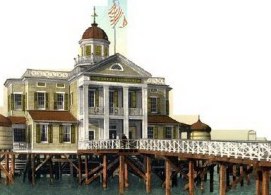
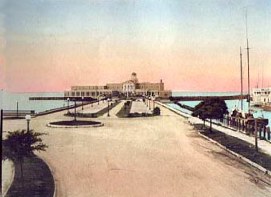
Pass Christian Yacht Club — PCYC 
Former Mayor Sam Heaslip continued this sport in the Pass. As a past Commodore of the Southern Yacht Club of New Orleans and having become involved in operating the Mexican Gulf Hotel, he helped organize the current Pass Christian Yacht Club in 1893. Joining with four other regional clubs, the Southern Gulf Coast Yachting Association was formed in 1901 and reorganized in 1920 as the Gulf Yachting Association.
 The first Pass Christian Yacht Club quarters was destroyed by the Hurricane of 1915. The Club sponsored sail racing in the Sound as well as motor boat racing in Bayou Portage. Following the depression years, in 1937 the down-sized Club was reorganized by a group of local citizens meeting at the old, red-brick, four-story, school-house on Scenic Drive and Hiern Avenue, when Bernard Knost was elected Commodore.
 Also, the newly formed Skipperette Club voted Mrs. Peggy Gause as its Commodore. In 1938, the Knost Regatta for female skippers came into existence, honoring Bernard Knost, and has since continued as an annual event of the Pass Christian Yacht Club.
 The Mander’s Beach lot property located south of Scenic Drive between Hiern Avenue and Market Street was purchased for a new clubhouse. The hurricane of 1947 caused some damages to it, followed by its expropriation in 1953 by the Mississippi Highway Department for four-lane construction of U.S. Highway 90.
 Above 1950s photo shows Lipton Regatta participants -- Left to Right: Donald Sutter, Tut Alfonso, Oscar Cassibry, Jr., Oscar Cassbry, Sr., W.L. Bill Barbour, Vincent Alfonso, Joe Alfonso, and Bob Lefeure.
 On July 26, 1953, PCYC celebrated its new location on the peninsula that juts into the Sound from the foot of Market Street. The man-made peninsula originated from previous oyster canneries which had dumped oyster shells for many decades. A Quonset hut, once used by the old Dunbar-Dukate canning company, was renovated into new quarters for the Yacht Club. In June of 1958, the Club negotiated a property and lease exchange with the City administration and now owns parts of the property in addition to leases effected in 1985, 1991, and 1992. (The above photo shows 1965 Hurricane Betsy damages -- Below is Camille.)
 Then came August of 1969, when the old Quonset Hut was obliterated by Hurricane Camille. This resulted in a temporary clubhouse being established in the then vacant Crescent Hotel at 127 W. Beach. (The site of the current Harbour Inn located on Scenic Drive on the ridge above from where the PCYC had its earlier club at the Mander’s beach lot.)
 Ribbon cutting for the present Club headquarters took place on December 16, 1971. Its first addition took place in 1975, and it was expanded, renovated, and redecorated in 1987. Again, in '95 and '96, extensive renovations were made to the building and its docks. PCYC also sports a four-lane regulation swimming pool measuring 35 x 82 feet.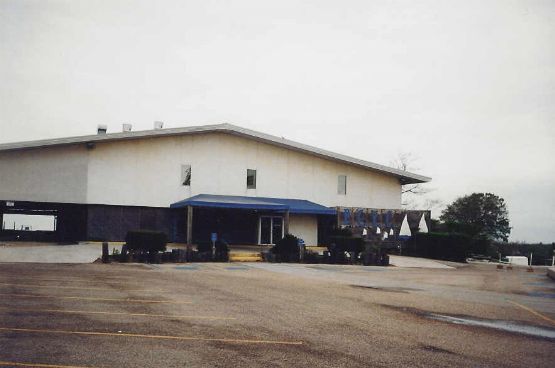
 During a stopover at Curacao, Dr. Rafferty became aware of a large anchor which intrigued him and he re-visited it during follow up port calls. The doctor purchased the huge anchor and enlisted several crewmen to have it secreted aboard ship without the knowledge of the ship’s captain.
 At New Orleans once more, the anchor was quietly taken off the vessel and stored in a warehouse until Rip Terrell and Harry Wittmann were able to arrive with a flat-bed truck to hoist it and bring it to Pass Christian where Harry Spence was waiting with his wrecker. Dr. Rafferty presented it to the PCYC along with a plaque which he fictitiously inscribed as follows.
"Anchor from British Bell, slaver, 350 ton square rigged ship. Sailed from Accra, West Africa, consigned to a New Orleans firm. Foundered on the island of Little Curacao. D-W-I on her maiden voyage, Good Friday, March 20, 1834. Captain and crew of 108, cargo of 210 human beings lost. Mayhap by the wrath of an angry God. Donated to Pass Christian Yacht Club by Physician, Traveler and Cosmopolite."
The large anchor, showing a shank approximately 12-feet-long – with flukes approximately 8-feet-long is located on the Yacht Club’s lawn.
Go to Next Page for Current Yacht Club -- "Bigger and Better"

The Pass Christian Yacht Club has weathered many an adversity and numerous times the Clubhouse has given way to the overpowering forces of Mother Nature. With the guidance of its Commodores, the enduring spirit of its members, and their love of the sport of sailing --- has enabled the Club to survive its hardships, rebuild and to grow and prosper in the ensuing years. The P.C.Y.C. has been housed in diverse quarters on various sites in Pass Christian.
Formal organization of the Pass Christian Yacht Club was in 1893.
Hurricane 1915 destroyed the Club
In 1928, Luther H. Barksdale was elected Commodore
In 1929, Commodore J.M. Terrell
From a news-clipping – Guy Northrop was Commodore
P.C.Y.C. was reorganized and incorporated in 1935
In 1937, a group of local citizens met at the old red school house on Hiern Avenue and Scenic Drive, and reorganized the club. Bernard Knost was the first commodore of the re-organized club.
In 1938, the Knost Regatta for female skippers came into existence honoring Bernard L. Knost.
The Skiperette Club was organized in March 1937 with 26 members attending, with Mrs Peggy Gause as its Commodore.
The club bought property south of Scenic Drive between Hiern Avenue and Market Street for its new clubhouse. The 1947 hurricane damaged it. This property was usurped in 1953 by the Mississippi Highway Dept to build Highway 90
In 1949, July 4th weekend, the Pass Christian YC celebrated 100 years of yachting in the South
In July 26, 1953, the club celebrated its purchased the land on the cannery peninsula southward into the Gulf from the foot of Market Street, east of the actual roadway. The club also leased a launching spot from the the city at the southern tip of Market Street. The quonset building , once used by the canning company at the extyreme southeren tip of the peninsula was renovated as new quarters for the Yacht Club.
In June of 1958, Commodore J.W. Terrell and John M. Parker, Jr. represented the P.C.Y.C.'s exchange of property and leases adjoining the harbor wall on inside the harbor, for property belonging to the city adjacent (Market Street) to the Yacht Club building.
Sep 9, 1965 Hurricane damages to the club resulted in need for much renovation
In 1969, Hurricane Camille leveled the old Quonset Hut clubhouse resulting in a temporary clubhouse being established in the then vacant Crescent Hotel (Harbour Inn).
In 1971, the present clubhouse was built and occupied at the site on the south end of the peninsula. Commodore Sydney Ellis, Jr., supervised the construction of the present building. The first addition to the building took place in 1975 under Commodore Byron W. Stinson.
In 1985, the P.C.Y.C. renewed leases with the City, 25 year renewal of the piers in the Southeast corner of the harbor for $1 per year, and renewal of the lease for the parking lot.
In 1987, under the direction of Steve Montagnet, Jim Schmidt and Chuck Taylor, the P.C.Y.C. was expanded, renovated, redecorated, and in 1988, rededicated with Commodore James A. Wiliams at the helm.
Strife with the City began in 1989 when P.C.Y.C. would not let city have access to its grounds necessitating the city having to tear up US 90 in order to pass water and sewerage pipe under it to the harbor.
July 1990, Pass Inc. got one year license to dock a gambling boat. Mayor Ted Lawyer wanted to know why P.C.Y.C. didn't pay property taxes.
June 1991, P.C.Y.C. has 2.3 acres of property which had been on the non-profit tax role since 1986 paying no taxes, parking lot lease was settled in addition to swapout for taxes on parking leases. The County Comfort station (proposed construction) needed ingress and egress across P.C.Y.C. owned property.
Progress News -- Nov 12, 1991, The City paid P.C.Y.C. $60,800 for two parcels in settlement. Roadway access to the rear of BP to the Comfort station and one lot to the East of BP.
Sun Herald News -- Feb 10, 1992, On swap-out lease purchases, the City took access to an 80,000 sq.ft. parking lot and the P.C.Y.C. took 27,300 sq.ft property consisting of boat loading hoist and adjacent land not including boat ramp.
August 29, 2005 -- KATRINA